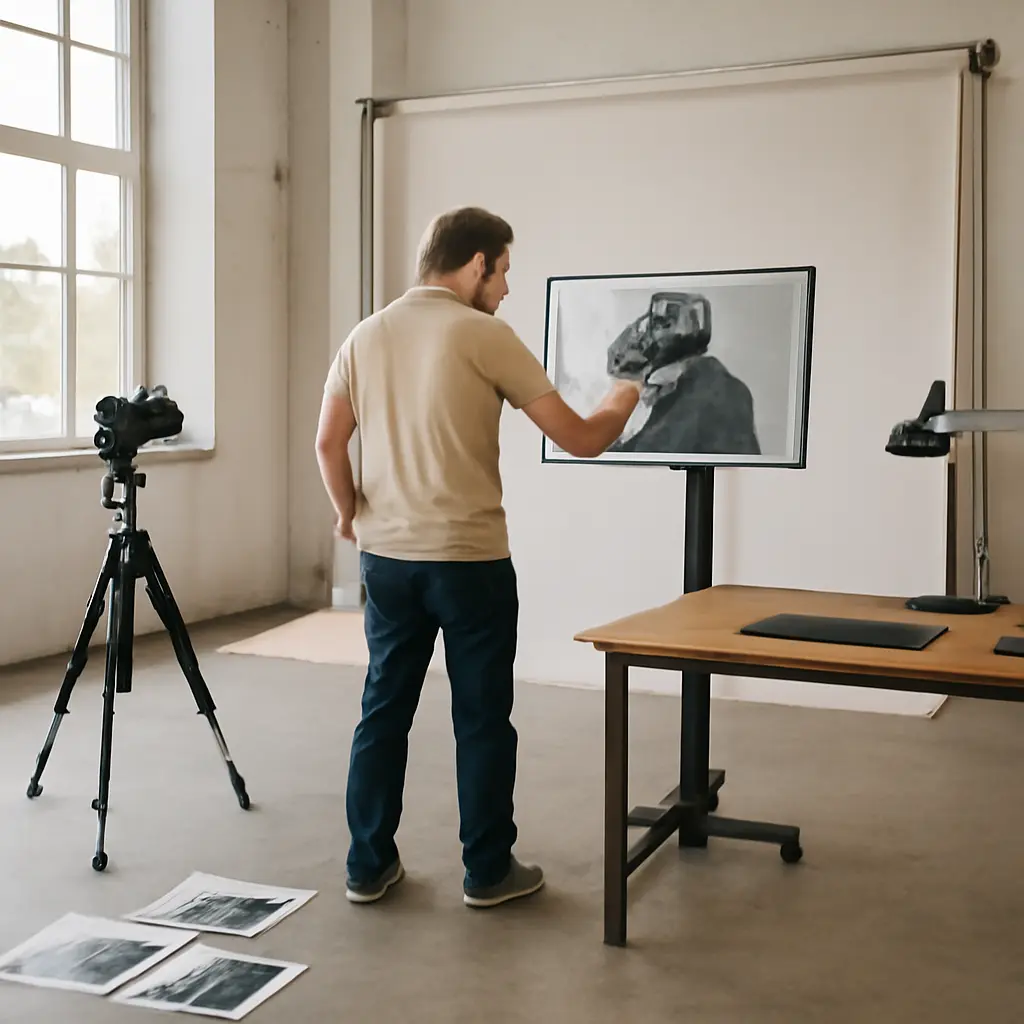
A portfolio is a deliberately selected body of work, not simply a collection of an artist’s strongest individual images. Portfolio curation discipline means choosing photographs that reinforce a clear visual and conceptual direction—even when that means setting aside technically excellent pictures. This approach matters in a crowded visual marketplace: the World Press Photo Foundation reported receiving 61,062 photographs from 3,851 photographers for its 2024 contest, a reminder that editors and audiences encounter work through selective presentation. A cohesive series helps viewers recognize its subject, mood, and point of view; sequencing and audience-specific editing make that cohesion legible; and periodic review prevents an otherwise compelling outlier from weakening the whole.
Portfolio Curation Defines Series Cohesion
Portfolio curation is the process of selecting, grouping, sequencing, and presenting work to communicate an intentional point of view. In photography, a series is a set of images connected by subject, method, visual treatment, or argument. Cohesion does not require every frame to look identical: it requires each included image to contribute meaningfully to the series’ overall experience.
Photographic institutions and editors commonly distinguish between an image’s standalone strength and its role in a larger edit. World Press Photo’s contest structure, for example, recognizes both individual photographs and stories, underscoring that a powerful single image and an effective sequence are related but different achievements. The practical test is not merely “Is this a good photograph?” but “Does this photograph belong here, and what does it add?”
The relevant hyponyms—or more specific forms—include portfolio editing, series editing, sequencing, visual consistency, and audience-specific presentation. Together, these practices help photographers preserve strong images without asking every image to serve the same project.
Standalone Merit Versus Series Function
Standalone merit describes an image’s effectiveness on its own: its composition, timing, emotional force, technical control, or originality. Series function describes how it behaves among neighboring images. A dramatic portrait may be excellent alone but distract from a quiet landscape sequence if it introduces a new subject, scale, color treatment, or emotional register without advancing the series.
This distinction is especially important in editorial and documentary work. The National Press Photographers Association’s Code of Ethics emphasizes accurate representation and avoiding the manipulation of photographic content. Applied to curation, that principle encourages editors to consider whether an image clarifies the story or changes its meaning through selective placement—not simply whether the photograph is visually arresting.
Cohesion Without Repetition
Cohesion is a recognizable relationship among images, not a demand for sameness. Recurring light, framing, color, subject matter, location, or perspective can create unity; variation in distance, rhythm, or emotional intensity can keep the sequence alive. The useful question is whether a variation develops the series or pulls attention away from it.
A strong edit therefore balances consistency with progression. Repeating nearly identical frames can make a portfolio feel redundant, while one carefully chosen departure may provide contrast, reveal a new layer, or mark a turning point. An outlier becomes disruptive when its difference feels unexplained rather than purposeful.
Portfolio Editing Tests Strong Images for Fit
Portfolio editing is the evaluative stage in which a photographer compares images against the project’s purpose and removes those that weaken its coherence. The process should be criteria-led, not a referendum on personal attachment. Before selecting, write a one-sentence description of the series: its subject, perspective, and intended viewer experience. Then test each image against that description.
A useful edit considers several connected dimensions: subject relevance, visual language, narrative contribution, quality relative to neighboring frames, and the expectations of the intended audience. These criteria are not a universal scoring system; they are safeguards against keeping an image merely because it took effort to make or receives praise when shown alone.
Subject and Conceptual Relevance
Subject relevance asks whether a photograph belongs to the series’ stated concern. Conceptual relevance asks whether it deepens that concern. A street photograph may share a city with a project about migration but still have little purpose if it neither adds evidence nor expands the viewer’s understanding of movement, place, or belonging.
Try a practical caption test: write one sentence explaining what the frame contributes that no other image does. If the explanation depends mainly on how difficult, beautiful, or personally meaningful the photograph is, rather than on its relationship to the project, it may belong in another portfolio.
Visual Language and Technical Consistency
Visual language includes recurring choices such as contrast, color palette, focal length, camera distance, lighting, grain, and framing. Technical consistency means those choices feel intentional across the set. It does not mean that every file must share identical exposure or processing; it means deviations should support the project rather than appear accidental.
A useful review is to make a contact sheet or thumbnail grid. At small scale, shifts in color, density, and composition become easier to spot than when viewing each image full-screen. The grid also reveals clusters of near-duplicates and abrupt stylistic changes. Where appropriate, a chart can map images by subject, color, viewpoint, or emotional intensity to show whether a supposed series has a coherent visual pattern.
Narrative Contribution and Sequence
Narrative contribution is the role a frame plays in the sequence: establishing a place, introducing a person, supplying context, creating a pause, or changing the viewer’s understanding. Sequencing is the arrangement of those roles over time or across a presentation. An image can fit the subject and visual style yet still be unnecessary if it repeats information already communicated more clearly elsewhere.
Test the sequence by viewing it in several formats: as a contact sheet, as a slideshow, and in the intended final layout. Reorder the images and note where momentum improves or stalls. If removing a frame makes the series clearer without creating a gap in meaning, that is evidence the image may be stronger outside the edit.
Outlier Removal Protects Portfolio Cohesion
Outlier removal is the deliberate decision to exclude an image whose strengths do not compensate for the disruption it creates in a particular series. It is not a judgment that the photograph is worthless. The image may be excellent in a different context, such as a standalone gallery, a separate project, a personal archive, or a client portfolio organized around another brief.
This distinction matters because photographers often confuse curation with ranking. A portfolio is not necessarily a list of the artist’s ten most impressive images. It is an argument made through images, and a less spectacular frame may be essential if it provides context, while a dazzling frame may be counterproductive if it changes the argument.
When to Remove a Powerful Outlier
Consider removing or relocating an image when it introduces an unrelated subject, breaks the established visual treatment, repeats a stronger frame, shifts the project’s tone without a narrative reason, or attracts attention away from the series’ central idea. Also examine whether the image’s impact depends on background information that viewers will not have in the portfolio presentation.
Use a three-question check before cutting it:
- Does the image advance the series’ stated subject or point of view?
- Does its difference create purposeful contrast, or merely interrupt the visual rhythm?
- Would the series lose essential information if the image were removed?
If the image fails the first two questions and the answer to the third is no, archive it outside the series rather than forcing it into the edit.
A Real-World Editorial Lesson
The distinction between a single photograph and a story is visible in major photojournalism competitions. World Press Photo’s 2024 contest received 61,062 photographs from 3,851 photographers and awarded work across both single-image and story categories. Those figures do not prove that every winning story follows one visual formula; they illustrate the scale of selection and the different editorial task involved in judging a photograph versus a connected body of work.
For photographers, the lesson is to edit for the form being presented. A striking frame can succeed as an individual entry while failing to serve a particular sequence. Conversely, a quieter contextual image may be indispensable in a story even if it would not be the strongest standalone submission.
Audience-Specific Portfolios Translate Cohesion
Audience-specific curation adapts the selection and sequence to the viewer’s purpose without misrepresenting the work. A gallery presentation may prioritize conceptual development and pacing; a commercial portfolio may foreground relevance to a client’s brief; an editorial submission may emphasize clarity, accuracy, and narrative progression. The same image can be appropriate in one context and distracting in another.
The bridge between cohesion and audience is intention. Define who will view the work, what they need to understand, and how much context they will receive. This makes cuts easier to defend and helps prevent a portfolio from becoming a catch-all collection of unrelated successes.
Separate Projects Instead of Diluting One
When strong images point toward different themes or visual systems, create separate portfolios or project sections rather than weakening one series. A documentary project, a formal still-life study, and a set of experimental night photographs may all belong to one photographer’s practice without belonging in the same sequence.
A simple portfolio structure can preserve that breadth: a concise landing selection, clearly named project galleries, and a separate archive or “other work” section. This lets a photographer remain versatile while giving each body of work its own visual logic.
Review, Feedback, and Version Control
A review cycle helps distinguish a temporary attachment from a lasting editorial need. Step away from the work, return with the series statement, and ask a trusted reviewer to describe what they think the project is about before explaining it. If viewers consistently identify the outlier as the main subject or interpret the series as several unrelated projects, revisit the edit.
Keep a record of alternate sequences and removed images. Version control allows experimentation without permanently discarding work and makes it possible to tailor a selection for different uses. A practical workflow is to preserve the original archive, label the current edit, date each major revision, and note why significant images were moved or removed.
Conclusion: Curate the Series, Preserve the Image
Portfolio curation discipline treats series cohesion as a deliberate editorial outcome. Portfolio editing distinguishes standalone merit from series function; visual and narrative tests reveal whether an image contributes; and outlier removal protects the project without denying the photograph’s individual strength. Audience-specific presentation and versioned review help photographers show different parts of their practice without combining incompatible work.
The broader implication is that a portfolio communicates not only what a photographer can make, but how thoughtfully they can select and organize it. Write a one-sentence series statement, build a contact sheet, test each image for a distinct contribution, and move strong but disruptive frames into a separate project or archive. The goal is not to make every portfolio smaller; it is to make every included image earn its place.
Sources: World Press Photo Foundation, “2024 Contest: The Results,” https://www.worldpressphoto.org/collection/photocontest/2024; National Press Photographers Association, “Code of Ethics,” https://nppa.org/resources/code-ethics.